Sunday, March 28, 2010

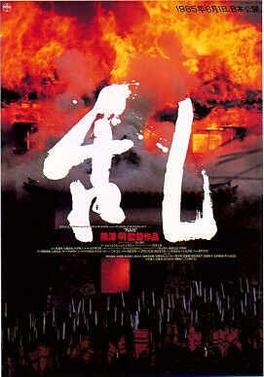
#316 Ran - Japan 1985- Akira Kurosawa

I just watched Ran on the big screen at the Coolidge Corner Theater. It was re-released to celebrate Kurosawa's centennial. I have to admit that I am a big fan of Japanese cinema, and love the films I have seen from Yasujiro Ozu and Kenji Mizoguchi, but had yet to sit through an entire Kurosawa film until today. I have attempted to watch them in the past, but few held my attention or distractions won me from the television set. So, Kurasowa's final epic was my first Kurosawa film, and it will definitely not be my last.

乱 - Ran, is translated as 'revolt; rebellion; war;' and the film is all about war and the chaos that it creates. We watch the Ichimonji clan fall after its leader Hidetora passes the torch to his sons who then betray him. It is revealed that Hidetora gained all of his wealth and power through treachery and the viewer watches the sons betray him, and then each other, for a taste of power - all only sip the broth before being taken out by the next in line. The film opens with a tired Hidetora falling asleep during a meeting with his sons and another clan. When he awakes he is frightened by a nightmare where he finds he is completely alone and afraid. At this point in the film, I thought Hidetora might be going a little mad -his sons exclaim that he is exhausted, and the rash behavior that follows this nightmare seems to occur as a result of it - he declares his retirement, which seems sudden, based on the reactions of his sons and advisers. He decides to give his leadership and his first castle to his first son Taro, his second castle to his second son Jiro, and his third castle to his third son Saburo. The first and second sons begin praising their father, thanking him for his faith in them and then renouncing their own abilities. Saburo laughs at his brothers for their insincere speeches and mocks Hidetora for being naive enough to pass all of his power to his sons without thinking that they could possibly use it against him. Hidetora becomes enraged at Saburo's remark and assumes that jealousy is to blame for his negative outlook. Hidetora uses a stack of arrows to show his sons that together, they cannot be broken. Taro attempts to snap the arrows, and then passes it on to Jiro, who fails and hands it to Saburo who forces the pile in half. Saburo exclaims that the example was wasted on them, and tells his father that he is making a big mistake. Tango, Hidetora's servant, comes to defend Saburo, and explains that he is not a jealous person and that his reasoning should be heard. Hidetora banishes them both, and the story begins.

From that point on, the film follows Hidetora's descent into madness after his sons turn against him. Taro declares war on his father, and while Hidetora's guards and servants are destroyed, Jiro takes advantage of Taro's vulnerable position on the battle field, and has him killed. My description of the plot during this part of the film does little justice to the intensity here; this scene is full of bloodshed, and it is long. Very long. I cannot tell you how many times I expected Hidetora to be taken out. He sits in the tower of the third castle (it was abandoned after Saburo was banished), and arrows fly through the tower and kill all of the people that are in their with him (aside from the concubines that commit seppuku). After awhile, there are more arrows than guards or castle, and the bloodshed still continues. The thought that this kind of attack could be conducted on a father by a son who was trusted completely with the leadership that he was given, is considerably surprising. Kurosawa really wanted to put across that this family was completely without bonds, it is all just business and politics. Hidetora is left to commit seppuku after all of his people are massacred, but he cannot because his sword is broken. He instead loses his mind. After Taro is killed, Hidetora escapes the castle by walking out, past the guards, past the death -he simply walks out alone- a tired and insane old man.

Hidetora's madness is a death in itself, as it is the end of his lust for power and, therefore symbolically the death of his former self. Madness permits him to remain alive, though it forces him to face his mistakes -a trade off which serves as his punishment and redemption- he heads into the wilderness and is faced with, what can be assumed are, visions of the past and the dead haunting him. Hidetora is not alone as he wanders the wilderness, he has his servant jester Kyoami at his side, and Taburo, his loyal guard who returns to him in spite of his banishment. Because he is insane, he is of no threat to Jiro, and is left alone. During this time, Jiro takes control of the first castle and is immediately seduced by the widow of Taro, Lady Kaede. It was Lady Kaede who encouraged Taro to turn against his father and when he dies she turns to Jiro in order to remain powerful in the very castle that once belonged to her family. She secures her position by seducing Jiro and then ordering the death of his wife, Lady Sué.

Saburo goes to his brother Jiro to search for his father. He explains that he has no interest in power or wealth, he just wants his father to be safe. Jiro is skeptical of Saburo's motives and also nervous that tending to Hidetora will cure him of madness and that he will be a threat to him. By the time that Saburo finds Hidetora, his madness has subsided and he is able to tell Saburo that he would like to finally be a father to him, and cannot wait to sit and talk with him and to share his experiences with his son. While this is all taking place, Jiro's army attacks Saburo's and Saburo's men kill Jiro. Jiro's men fulfill the execution of Lady Sué, and his own men kill Lady Kaede. Finally, while Hidetora rides on the back of Saburo's horse, Saburo is shot by Jiro's assassin and Hidetora succumbs to death while crying over his son. All that remain are those who devoted their lives and service to the fallen.

Saburo's forgiveness pulled Hidetora from madness and brought back his sanity. Like the arrows Saburo broke at the beginning of the film, all bonds to leadership and control are broken. Though this rebirth was short lived, as the illegitimate power of the Ichimonji clan came to a complete close when it collapsed on itself. There are no sons, wives, or families to succeed this final battle. The castles and wealth are destroyed and there are no victors to claim leadership. Perhaps, in order for Hidetora to die, his kingdom had to fall, the arrows had to break; he had to first face the atrocities of his leadership in order to earn redemption through madness. The story reveals that war is senseless and that power is often attained through neglect, treachery, and divisive means.

Tuesday, March 23, 2010

#295 Crazed Fruit / Kurutta Kajitsu Japan 1956 Kô Nakahira


Water does not ask for forgiveness. It has the potential to destroy things necessary to our survival and to take our lives, but it does not need our forgiveness because we are of the water; we need it to live and our bodies are tuned to the tides. In Kô Nakahira's Crazed Fruit - Kurutta kajitsu, everything occurs by the water side. The film follows a group of wealthy, young people in Japan during the 1950's. At no point do we see any of these people working, they spend their time water skiing, partying, and are preoccupied with sex. The narrative follows brothers that become infatuated with the same girl.

Haruji, the younger brother, first notices Eri at a train station and is instantly smitten with her. Haruji is innocent and it can be seen in his immediate devotion to this girl who he has yet to know; he is instantly blind to all others. The older brother, Natsuhisa immediately passes Eri off as too young and inexperienced looking, declaring that she is just like, and therefore perfect for, his brother. The morals and desires of these siblings contrast from the very beginning: innocence vs. experience, naivete vs. cynical, selfless vs. selfish. We are immediately aware of Natsuhisa's attitude toward and experience with women. In an early scene, the pair ride around on their boat and Natsuhisa jokes that he is only out on the water to pick up girls, sizing up a few that they pass by while Haruji shyly avoids the subject. His brother teases him for still thinking about the girl (Eri) at the train station. When they return to the shore, Natsuhisa declares that it was a boring day; it is obvious that Haruji enjoyed his brother's company on the water, as he seems disappointed by his brother's remark. The scene reveals Natsuhisa's jaded point of view; he is incapable of making the best of the situation because their is no one to desire, or way for him to be desired. To Natsuhia, everything beyond sexual desire is just passing time.

Throughout the film the ocean is the backdrop to many of the events surrounding Haruji. The water and seaweed dance as nervous sexual tension between Haruji and Eri plays out, visually painting the confused physical and emotional state for us. Later, the steady dance of gentle waters is focused on while the pair engage in sexual activities, revealing anticipation and celebration with its steady beat. The ocean is almost always calm, even as the tension escalates between Haruji, Natsuhisa, and Eri. And like Haruji, the water is unsuspecting and eager. It participates in and witnesses the affair from every angle and chooses only to react when prompted.

Haruji does just that when he finds out that his brother has taken Eri on a camping trip that Haruji had originally invited her on. For the first time, he is told directly that Eri is no good and that she has been seeing his brother for some time. With verbal confirmation of the affair that he had previously only had an inkling of before, Haruji borrows a boat and speeds out into the ocean to catch the pair in the act. He approaches their sailboat in a dazed exhaustion, circling it furiously for several minutes. The scene is shot from above and the viewer can see an angry whirlpool forming around the sailboat. This is the first time that we can see the extent of Haruji's anger. And with the aid of the circling water, it is obvious that the innocence which caused him to feel unsure, confused, gentle, and eager, has transferred into emotional fury fueled by anger. We watch him drive away from the scene, and Eri jumps into the water in a desperate cry for help, attention, or perhaps even sympathy, and Haruji makes a complete u-turn and races back to take his revenge.

I have to admit, I did not suspect that Haruji might kill Eri and Natsuhisa. His naive manner had tricked me to thinking he was a gentle soul, wronged and subsequently tainted by love, just like his elder brother. I assumed that love, as portrayed through his relationship with Eri, would destroy his innocence and that the end would reveal Haruji behaving as Nastuhisa did throughout the film. His short relationship with Eri would destroy his innocence and his relationships with women forever. Eri's motivations are difficult to figure out because her situation is only touched on. We know that she is young (around 20 years old), that she married young, and that a hope to experience what she claims to have missed when she married is the reason for her infidelity. It can be concluded that by dating a younger, inexperienced man, she hopes to experience, or regain, her own lost innocence. Eri is caught between three worlds: her reality (her marriage), her lost innocence (Haruji), and the truth of the lie (Natsuhisa). I say the truth of the lie because her relationship to Natsuhisa is just that: he knows the truth, that she is married and that she cheats on her husband, he knows that Haruji is innocent, and that his innocence is the reason why she is attracted to him and that he himself will never appeal to her in the same way. But, Natsuhisa realizes that the innocence that Eri longs for cannot be obtained through Haruji. By taking advantage of his knowledge of her situation, he becomes her mirror, and reflects what she actually is doing to the people around her. It is through Natsuhisa that we come to understand her motivations.

For Eri and Natsuhisa, desire trumps true love, friendship, and family; they never ask for forgiveness or permission, taking what they want and leaving debris in their path. In the end, Haruji is the victim of this selfish desire, his moral victory a tragedy: his innocence lost, his lover is dead, his family destroyed.