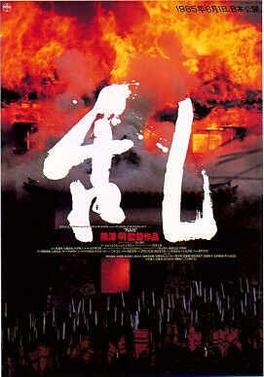
From that point on, the film follows Hidetora's descent into madness after his sons turn against him. Taro declares war on his father, and while Hidetora's guards and servants are destroyed, Jiro takes advantage of Taro's vulnerable position on the battle field, and has him killed. My description of the plot during this part of the film does little justice to the intensity here; this scene is full of bloodshed, and it is long. Very long. I cannot tell you how many times I expected Hidetora to be taken out. He sits in the tower of the third castle (it was abandoned after Saburo was banished), and arrows fly through the tower and kill all of the people that are in their with him (aside from the concubines that commit seppuku). After awhile, there are more arrows than guards or castle, and the bloodshed still continues. The thought that this kind of attack could be conducted on a father by a son who was trusted completely with the leadership that he was given, is considerably surprising. Kurosawa really wanted to put across that this family was completely without bonds, it is all just business and politics. Hidetora is left to commit seppuku after all of his people are massacred, but he cannot because his sword is broken. He instead loses his mind. After Taro is killed, Hidetora escapes the castle by walking out, past the guards, past the death -he simply walks out alone- a tired and insane old man.
Hidetora's madness is a death in itself, as it is the end of his lust for power and, therefore symbolically the death of his former self. Madness permits him to remain alive, though it forces him to face his mistakes -a trade off which serves as his punishment and redemption- he heads into the wilderness and is faced with, what can be assumed are, visions of the past and the dead haunting him. Hidetora is not alone as he wanders the wilderness, he has his servant jester Kyoami at his side, and Taburo, his loyal guard who returns to him in spite of his banishment. Because he is insane, he is of no threat to Jiro, and is left alone. During this time, Jiro takes control of the first castle and is immediately seduced by the widow of Taro, Lady Kaede. It was Lady Kaede who encouraged Taro to turn against his father and when he dies she turns to Jiro in order to remain powerful in the very castle that once belonged to her family. She secures her position by seducing Jiro and then ordering the death of his wife, Lady Sué.
Saburo goes to his brother Jiro to search for his father. He explains that he has no interest in power or wealth, he just wants his father to be safe. Jiro is skeptical of Saburo's motives and also nervous that tending to Hidetora will cure him of madness and that he will be a threat to him. By the time that Saburo finds Hidetora, his madness has subsided and he is able to tell Saburo that he would like to finally be a father to him, and cannot wait to sit and talk with him and to share his experiences with his son. While this is all taking place, Jiro's army attacks Saburo's and Saburo's men kill Jiro. Jiro's men fulfill the execution of Lady Sué, and his own men kill Lady Kaede. Finally, while Hidetora rides on the back of Saburo's horse, Saburo is shot by Jiro's assassin and Hidetora succumbs to death while crying over his son. All that remain are those who devoted their lives and service to the fallen.
Saburo's forgiveness pulled Hidetora from madness and brought back his sanity. Like the arrows Saburo broke at the beginning of the film, all bonds to leadership and control are broken. Though this rebirth was short lived, as the illegitimate power of the Ichimonji clan came to a complete close when it collapsed on itself. There are no sons, wives, or families to succeed this final battle. The castles and wealth are destroyed and there are no victors to claim leadership. Perhaps, in order for Hidetora to die, his kingdom had to fall, the arrows had to break; he had to first face the atrocities of his leadership in order to earn redemption through madness. The story reveals that war is senseless and that power is often attained through neglect, treachery, and divisive means.


No comments:
Post a Comment